
QuantaDose Press Releases
Advocacy Toolkit: What Voters Should Demand From Senators Before Confirming the Next FDA Commissioner
Core message for advocates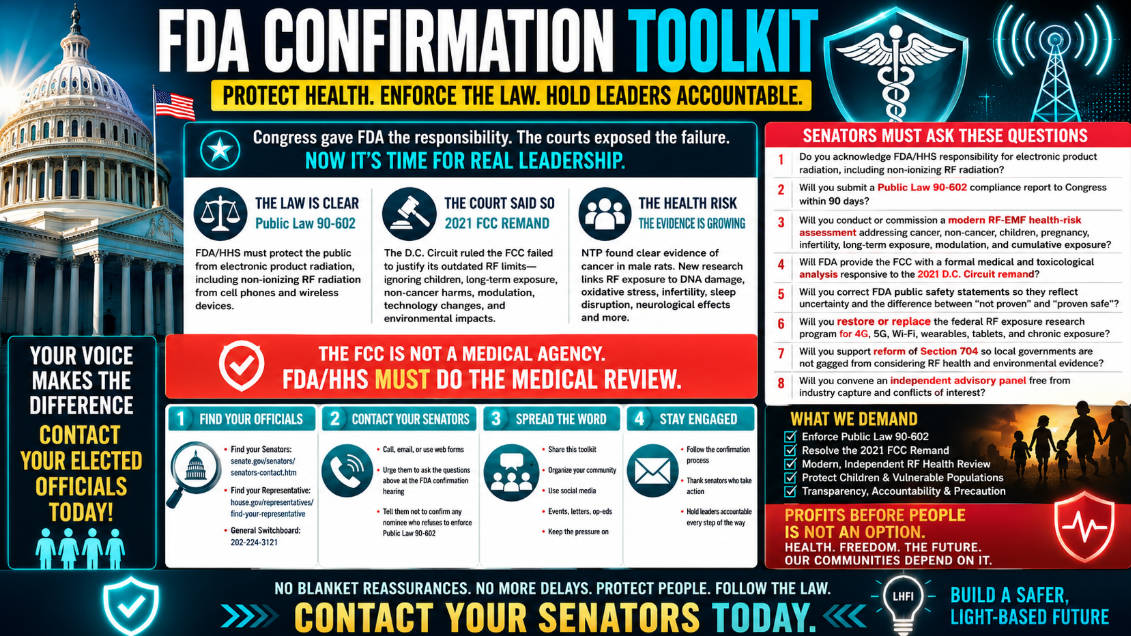
The next FDA Commissioner must not be confirmed until they publicly commit to enforcing Public Law 90-602, the federal electronic-product radiation law, and to helping resolve the FCC’s unresolved 2021 court remand on radiofrequency radiation exposure limits.
This is not simply an FCC issue. The FCC regulates communications and spectrum. HHS/FDA is where Congress placed the public-health responsibility for electronic product radiation, including non-ionizing electromagnetic radiation from products such as cordless and cellular telephones. FDA’s own summary of the law says electronic product radiation includes ionizing or non-ionizing electromagnetic radiation, and FDA lists cordless and cellular telephones as examples of covered non-medical electronic products.
The public should contact senators now and insist that any FDA Commissioner nominee be questioned directly, on the record, before confirmation.
Why this matters right now
FDA leadership is in transition. Reuters reported that FDA Commissioner Marty Makary departed in May 2026, that Kyle Diamantas was named acting head of FDA, and that former FDA leaders Stephen Hahn and Brett Giroir were among candidates under consideration for the permanent job.
The FDA Commissioner is appointed by the President with the advice and consent of the Senate, which means senators have both the authority and the responsibility to question the nominee before confirmation. Federal law also states that FDA’s mission includes protecting public health and safety from electronic product radiation.
The Senate HELP Committee is the key committee for FDA Commissioner nomination hearings. The committee’s own hearing page for the prior FDA Commissioner nomination identifies the proceeding as a nomination hearing for the Commissioner of Food and Drugs, and the HELP Committee’s current membership page lists the senators who should be pressured most directly.
The legal hook: Public Law 90-602
Public Law 90-602 was enacted to protect the public from radiation emitted by electronic products. It is now part of the Federal Food, Drug, and Cosmetic Act.
Under 21 U.S.C. § 360ii, the HHS Secretary must establish and carry out an electronic-product radiation-control program designed to protect public health and safety. That program includes performance standards, research, exposure evaluation, and procedures for minimizing exposure to electronic product radiation.
Under 21 U.S.C. § 360kk, the Secretary must prescribe performance standards for electronic products when necessary to protect public health and safety, and must consider the latest available scientific and medical data in the field of electronic product radiation.
FDA’s own cell-phone page admits FDA shares regulatory responsibilities with the FCC and says FDA is responsible for consulting on testing and evaluation of electronic product radiation and for collecting, analyzing, and making available scientific information on the hazards and control of electronic product radiation.
That is the basis of the advocacy demand: the next FDA Commissioner must enforce this law, not pass the responsibility back to the FCC.
The FCC remand connection
In 2021, the D.C. Circuit remanded the FCC’s decision to keep its old RF exposure guidelines. The court held that the FCC failed to provide a reasoned explanation for why its guidelines adequately protect against harmful effects of RF exposure unrelated to cancer. The court specifically faulted the FCC’s treatment of issues involving children, long-term exposure, RF pulsation or modulation, technological developments since 1996, wireless ubiquity, and environmental harm.
The court also criticized the FCC’s reliance on conclusory FDA statements. The court said FDA statements used by the FCC did not provide a reasoned explanation and did not explain why FDA rejected studies and comments raising concerns about RF exposure below current limits.
Children’s Health Defense has now filed a new case seeking a writ of mandamus to force the FCC to comply with that 2021 court order. CHD reports that the petition asks the D.C. Circuit to direct the FCC to comply within 90 days, require a 45-day status update, and halt wireless-infrastructure acceleration initiatives until the FCC complies.
That makes the FDA confirmation fight central. The FCC cannot credibly complete the medical and toxicological analysis alone. FDA/HHS must provide the health review the FCC lacks the expertise to perform.
The FDA messaging problem
In January 2026, Reuters reported that HHS would launch a study on cellphone radiation and that FDA had taken down old webpages saying cellphones are not dangerous. HHS said FDA removed old conclusions while HHS studies electromagnetic radiation and health research to identify knowledge gaps, including gaps involving new technologies.
Yet FDA’s current cell-phone page still says that the “weight of scientific evidence has not linked cell phone radio frequency radiation with any health problems” and that the scientific evidence does not show danger to children and teenagers.
That contradiction should be front and center in the confirmation hearing.
The nominee must be asked: If old blanket assurances were removed because they were outdated, why is FDA still allowing broad public reassurance language to remain without a modern Public Law 90-602 risk assessment?
Who advocates should contact
1. Your two U.S. senators
Your senators are the most important contacts because they vote on FDA Commissioner confirmation. The official Senate website provides senator contact pages, web forms, phone numbers, and the Capitol Switchboard number: 202-224-3121.
2. Senate HELP Committee members
The Senate HELP Committee handles FDA Commissioner nomination hearings. Advocates should especially contact HELP Committee members, including the Chair and Ranking Member, because they can question the nominee directly and submit written questions for the record. The committee’s current member list is posted on the official HELP Committee website.
3. Your House representative
House members do not vote on FDA Commissioner confirmation, but they can send oversight letters, pressure HHS/FDA, demand hearings, oppose wireless-expansion legislation, and support reform of Section 704. The official House website lets people find their representative by ZIP code.
4. Use official lookup tools
USAGov has a central tool for finding federal, state, and local elected officials. It links to official Senate and House contact resources.
The core demand to elected officials
Use this exact framing:
Before voting to confirm any FDA Commissioner nominee, senators must require the nominee to commit publicly and in writing to enforce Public Law 90-602, conduct or commission a modern RF-EMF health-risk assessment, formally assist the FCC in resolving the 2021 remand, correct outdated public-facing safety assurances, and restore or replace federal RF exposure research addressing modern wireless technologies.
Priority confirmation-hearing questions
These are the strongest questions senators should ask the nominee.
1. Public Law 90-602 jurisdiction
Do you acknowledge that HHS/FDA has statutory responsibility for electronic product radiation, including non-ionizing electromagnetic radiation emitted by electronic products such as cordless and cellular telephones?
Follow-up:
Will you commit to a written Public Law 90-602 compliance report within 90 days of confirmation explaining how FDA is carrying out its duties on research, exposure evaluation, public communication, exposure minimization, and performance standards for wireless RF radiation?
2. FCC remand responsibility
The D.C. Circuit remanded the FCC’s RF exposure decision in 2021 because the FCC failed to adequately address non-cancer harms, children, long-term exposure, modulation, technological change, wireless ubiquity, and environmental impacts. Will FDA provide the FCC with a formal medical and toxicological analysis responsive to the court’s remand?
Follow-up:
Will you commit that FDA will not allow the FCC to rely on conclusory FDA statements, but will instead provide a full evidence-based explanation?
3. FDA’s removed blanket assurances
HHS reportedly removed older FDA webpages saying cellphones are not dangerous while launching a new electromagnetic-radiation study. What scientific or legal basis remains for FDA’s current public statement that the weight of scientific evidence has not linked cellphone RF radiation with any health problems?
Follow-up:
Will you update FDA’s public-facing cell-phone safety pages so they clearly distinguish between “not proven” and “proven safe”?
4. Children and teenagers
FDA’s current public page says scientific evidence does not show danger to children and teenagers. Has FDA performed a modern, child-specific RF risk assessment that accounts for lifelong exposure, developing brains, smaller bodies, classroom Wi-Fi, tablets, wearables, 5G, and cumulative indoor exposure?
Follow-up:
Will you commit to a pediatric and developmental RF exposure review before FDA makes any broad public assurances about children?
5. NTP findings
The National Toxicology Program states that FDA nominated cellphone RF radiation for study because of widespread public use and limited knowledge about long-term health effects. NTP found clear evidence of malignant heart schwannomas in male rats and some evidence of malignant gliomas and adrenal-gland tumors. How will FDA formally evaluate those findings under Public Law 90-602?
Follow-up:
Will FDA publish a transparent risk-assessment response to NTP instead of simply repeating that no change to standards is warranted?
6. Restarting modern RF research
NTP studied 2G and 3G-type exposures, but modern exposure now includes 4G, 5G, Wi-Fi, Bluetooth, wearables, routers, tablets, and dense indoor environments. Will you commit to restoring or replacing the discontinued federal RF exposure research program with one designed for current and emerging technologies?
Follow-up:
Will FDA request the funding and interagency support necessary to carry out that research instead of allowing budget constraints to become an excuse for inaction?
7. Non-thermal biological effects
Does FDA still assume RF radiation is only a safety concern when it heats tissue, or will FDA evaluate non-thermal, modulation-specific, pulse-structure-specific, oxidative-stress, calcium-signaling, reproductive, neurological, and developmental endpoints?
Follow-up:
Will FDA state clearly whether a thermal-only framework is scientifically adequate for chronic, whole-population wireless exposure?
8. Current exposure limits
Will FDA conduct or commission an independent risk assessment to determine whether current FCC RF exposure limits protect against cancer, fertility impacts, pregnancy outcomes, neurological effects, sleep disruption, DNA damage, oxidative stress, and environmental harm?
Follow-up:
Will FDA evaluate benchmark-dose and low-dose extrapolation analyses, including recent work arguing that current public limits are far above levels estimated to protect against cancer and male reproductive harm?
9. Section 704 and local government preemption
Section 704 prevents local governments from regulating wireless facility placement based on RF environmental effects if facilities comply with FCC rules. Do you agree that federal health review must be current and medically defensible if local governments are preempted from acting?
Follow-up:
Will you support repeal or amendment of Section 704 unless FDA/HHS can certify that current RF exposure limits are medically current, protective of children and vulnerable populations, and responsive to the 2021 remand?
10. Independent advisory panel
Will you create an independent RF-EMF advisory committee with toxicologists, pediatricians, reproductive-health experts, neurologists, oncologists, environmental-health scientists, RF dosimetry experts, biomedical engineers, and public representatives?
Follow-up:
Will you exclude or limit participation by individuals with direct conflicts involving telecom industry funding or standard-setting bodies whose prior conclusions are under review?
11. WHO and ICNIRP reliance
Will FDA conduct an independent American review under U.S. law, or will FDA rely on WHO/ICNIRP-style international reviews to substitute for the statutory duties Congress assigned to HHS/FDA?
Follow-up:
Will FDA disclose all conflicts of interest for any experts used in RF safety review, including ties to industry-funded organizations and RF standard-setting bodies?
12. Device testing and real-world exposure
Will FDA evaluate whether current phone and wireless-device testing reflects real-world use, including body contact, pockets, children’s bodies, poor signal conditions, simultaneous transmitters, multiple devices, and chronic exposure?
Follow-up:
Will FDA work with FCC to require realistic consumer warnings and exposure-minimization instructions?
13. Formal timeline
Within 90 days of confirmation, will you deliver a written plan to Congress explaining how FDA will enforce Public Law 90-602 for wireless RF radiation?
Follow-up:
Within 180 days, will you provide Congress and the FCC with a formal medical and toxicological analysis addressing the 2021 remand issues?
14. Public correction
Will you commit that FDA public communications will no longer use blanket safety assurances unless FDA can produce the underlying risk assessment supporting those assurances?
Follow-up:
Will you replace blanket reassurance language with transparent language about evidence, uncertainty, precaution, and exposure reduction?
15. Confirmation commitment
Will you commit, as a condition of confirmation, that wireless radiation safety will not be treated as “somebody else’s problem” inside FDA?
Short phone script for constituents
Hello, my name is [NAME], and I live in [CITY, STATE]. I am calling about the next FDA Commissioner confirmation.
I want Senator [NAME] to ask the nominee direct questions about FDA’s legal duty under Public Law 90-602 to protect the public from electronic product radiation, including non-ionizing radiofrequency radiation from cell phones and wireless devices.
The FCC’s RF limits were remanded by the D.C. Circuit in 2021, and Children’s Health Defense has now filed a mandamus petition because the FCC still has not complied. But the FCC is not a medical agency. FDA and HHS must provide the medical and toxicological review.
Please ask the senator to demand that the nominee commit to:
- A 90-day Public Law 90-602 compliance report.
- A modern RF health-risk assessment.
- A formal FDA/HHS response to the FCC’s 2021 remand.
- Correction of FDA public safety statements.
- Restoration or replacement of federal RF exposure research.
- Protection of children, pregnancy, fertility, and vulnerable populations.
Please tell Senator [NAME] not to vote yes on any FDA nominee who refuses to make these commitments publicly.
Thank you.
Email template to senators
Subject: FDA Commissioner nominee must answer RF radiation safety questions before confirmation
Dear Senator [NAME],
I am a constituent from [CITY, STATE], and I am asking you to make wireless radiation safety a confirmation issue for the next FDA Commissioner.
This is not simply an FCC matter. The FCC regulates communications and spectrum, but HHS/FDA has statutory responsibilities for electronic product radiation under Public Law 90-602, now part of the Federal Food, Drug, and Cosmetic Act. FDA’s own materials state that electronic product radiation includes non-ionizing electromagnetic radiation, and that cordless and cellular telephones are examples of covered electronic products.
The D.C. Circuit remanded the FCC’s RF exposure decision in 2021 because the agency failed to provide a reasoned explanation for keeping its old limits, especially regarding non-cancer effects, children, long-term exposure, RF pulsation or modulation, technological developments, wireless ubiquity, and environmental harm.
Children’s Health Defense has now filed a mandamus petition seeking to force FCC compliance. But the FCC cannot perform the medical and toxicological review by itself. FDA/HHS must do the public-health work Congress assigned to them.
Please ask the FDA Commissioner nominee these questions before confirmation:
- Do you acknowledge FDA/HHS responsibility for electronic product radiation, including non-ionizing RF radiation?
- Will you produce a Public Law 90-602 compliance report within 90 days?
- Will FDA conduct or commission a modern RF-EMF health-risk assessment?
- Will FDA formally advise the FCC on the 2021 remand issues?
- Will FDA correct public-facing cell-phone safety language that overstates certainty?
- Will FDA restore or replace the discontinued federal RF exposure research program?
- Will FDA assess children, pregnancy, fertility, cancer, neurological effects, non-thermal effects, modulation, and cumulative exposure?
- Will FDA support reform of Section 704 so local governments are not gagged from considering RF health and environmental evidence while federal standards remain outdated?
Please do not vote to confirm any nominee who refuses to enforce Public Law 90-602 and provide the medical review the FCC cannot perform.
Sincerely,
[NAME]
[ADDRESS]
[PHONE OR EMAIL]
Short social-media post
The next FDA Commissioner must answer for wireless radiation safety.
The FCC is not a medical agency. HHS/FDA has the legal duty under Public Law 90-602 to protect Americans from electronic product radiation, including non-ionizing RF radiation.
Before confirmation, senators must ask:
Will FDA enforce the law?
Will FDA respond to the 2021 FCC remand?
Will FDA conduct a modern RF health-risk assessment?
Will FDA correct blanket safety assurances?
Will FDA protect children, pregnancy, fertility, and vulnerable populations?
Call your senators: 202-224-3121.
No confirmation without Public Law 90-602 compliance.
One-paragraph version for advocacy groups
The next FDA Commissioner confirmation is a defining moment for wireless radiation accountability. The FCC’s RF exposure decision was remanded by the D.C. Circuit in 2021, and Children’s Health Defense has now filed a mandamus petition seeking to force FCC compliance. But the FCC is a spectrum and communications regulator, not a medical agency. Congress placed electronic product radiation responsibility inside HHS/FDA through Public Law 90-602, including non-ionizing electromagnetic radiation from products such as cordless and cellular telephones. Senators must require any FDA nominee to commit, on the record, to a 90-day Public Law 90-602 compliance report, a modern RF health-risk assessment, a formal FDA/HHS response to the FCC remand, corrected public safety messaging, and restored federal RF exposure research. No nominee should be confirmed while treating wireless radiation safety as somebody else’s problem.
Best organizing plan
The strongest advocacy push is a three-wave campaign.
Wave 1: Before the nominee is named or immediately after nomination.
Ask every senator to make Public Law 90-602 and the FCC remand part of the confirmation process.
Wave 2: Before the Senate HELP hearing.
Target HELP Committee members with the hearing questions above and ask them to submit written questions for the record.
Wave 3: Before committee vote and floor vote.
Ask senators to withhold support unless the nominee commits to FDA-led RF review, public correction, and a formal FCC remand response.
The message should stay disciplined:
The FCC must comply with the court. HHS/FDA must do the medical review. Congress must make the next FDA Commissioner enforce the law.