
QuantaDose Press Releases
First-Principles Ebola Containment: High-Intensity Far-UVC Doffing Portals
May
The Bundibugyo Ebola outbreak in DRC’s Ituri Province presents a nightmare scenario: no approved vaccines and no approved therapeutics for this strain. Frontline healthcare workers are dying from healthcare-associated transmission.
We are trying to solve a hard physics problem with purely behavioral tools. It’s time for a first-principles intervention.
Ebola is primarily a fluid- and contact-driven filovirus. In treatment centers, the single highest-risk moment is PPE doffing. Exhausted workers in fluid-splattered suits are accidentally self-contaminating while removing their protective gear. Human error at this exact step is actively killing responders.
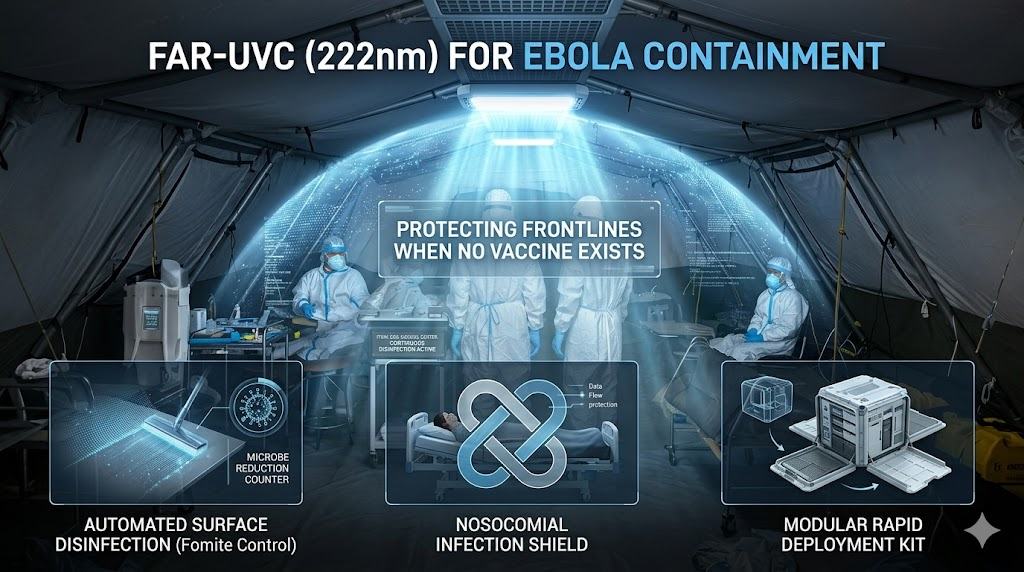
Far-UVC at 222 nm from filtered Krypton Chloride (KrCl) excimer lamps destroys viral RNA on surfaces within seconds. The manufacturing capacity for these systems was scaled dramatically during COVID. The hardware already exists. What we need is targeted, high-intensity deployment where it will have the greatest impact.
Here is the key engineering insight: In an Ebola ward, healthcare workers are already wearing full armor — Tyvek suits, polycarbonate face shields, and PET visors. These materials are completely opaque to 222 nm light. The person inside is fully shielded.
This changes the equation entirely. Because the worker is already protected by their PPE, we can move beyond normal low-power safety limits and deploy high-intensity Far-UVC decontamination portals directly outside the hot zones.
The protocol is straightforward: A healthcare worker steps into a compact, highly reflective chamber and assumes a brief “starfish” pose for 10–15 seconds. Multiple angled Far-UVC sources deliver an intense photon blast to the exterior of the suit, neutralizing the viral load before doffing even begins.
We sanitize the armor while the person is still safely sealed inside it. This directly closes the specific failure point that is currently costing lives.
Logistics in a conflict zone like Ituri present real challenges — diesel fuel is scarce and unreliable. Modern KrCl lamp arrays are efficient enough to be powered entirely by high-capacity battery systems paired with rapidly deployable solar blankets. This creates self-sustaining biodefense capability with minimal fuel dependency.
@elonmusk — this is a pure first-principles manufacturing, power systems, and logistics optimization problem. The biology has failed us because there is no vaccine for this strain. The physics is settled. The manufacturing lines already exist. What is required now is the decision to rapidly deploy rugged, solar-powered Far-UVC doffing portals and towers to the epicenters.
I am an RF engineer with direct experience building these KrCl systems and the holder of US Patent 11700058B2 for far-UVC biodefense technology. The regulatory pathway (ACGIH 2022) is clear. We do not need years of additional research and development. We need the logistical courage to get the lights into the field and protect the people holding the line.
The tech is ready. The need is urgent. Let’s apply first-principles engineering to this outbreak.
#FarUVC #Ebola #FirstPrinciples