
QuantaDose Press Releases
Why QuantaCase is a Truthful, Evidence-Grounded Case for RF Skeptics: A Deep Dive
In an era where wireless technology saturates our daily lives, skepticism about radiofrequency electromagnetic fields (RF-EMF) is not just warranted—it’s essential. For those questioning the safety of constant exposure to cell phone radiation, QuantaCase (also known as TruthCase™) emerges as a beacon of transparency and evidence-based design. Developed by RF Safe, this anti-radiation phone case doesn’t promise miracles or zero-risk utopia; instead, it offers a practical, physics-first tool grounded in the undeniable science of non-thermal biological effects. This deep dive explores why QuantaCase stands out as a truthful option for RF skeptics, drawing from the latest 2025 research, regulatory critiques, and the product’s own verifiable features. We’ll unpack the science, the design, and the broader implications, all while sticking to facts without hype.
The Scientific Foundation: Non-Thermal Effects Are Real and Below Guidelines
RF skeptics often face dismissal with claims that “guidelines protect us” or “effects are only thermal.” But the evidence tells a different story: Non-thermal biological effects from RF-EMF occur at exposure levels far below current thermal-based limits (e.g., SAR < 0.08-2 W/kg), and this is a consensus fact among researchers reviewing the data. These effects—alterations in ion channel timing, oxidative stress via reactive oxygen species (ROS), metabolic function, and quantum spin-dependent reactions—are documented in thousands of peer-reviewed studies, with no credible source denying their existence.
Consider the scale: Dr. Henry Lai’s 2025 analysis of over 2,500 studies from 1990-2025 found 70-91% reporting significant non-thermal impacts, including 89-91% for oxidative stress, 77% for neurological changes, 83% for reproductive/developmental issues, and over 150 studies on genetic/DNA damage. A 2025 Frontiers review of 131 oxidative stress studies reported 95% positive results at sub-thermal exposures, often ELF-modulated. The BioInitiative Report’s 2025 updates, covering ~1,800 studies, affirm a majority showing effects across organ systems.
High-certainty animal evidence from WHO-commissioned 2025 reviews: RF-EMF exposure causes heart schwannomas (high certainty) and gliomas (moderate certainty) in rats at non-thermal levels. These conserved mammalian mechanisms (e.g., S4 gating jitter as an “upstream error source”) make the data relevant without direct human causation claims.
Population signals add weight: Denmark’s 2023-2024 Cancer Registry reports dramatic CNS/brain tumor increases, with incidence up 107% in women (692 to 1,432 cases, 2004-2023) and similar in men, among the fastest-growing cancers from 2014-2023. While multifactorial, this challenges “no spike” narratives amid widespread RF use.

QuantaCase’s truthfulness starts here: It doesn’t ignore this science but designs around it, emphasizing precaution without claiming to “block” all risks.
QuantaCase’s Design: Features Backed by Evidence, Not Exaggeration
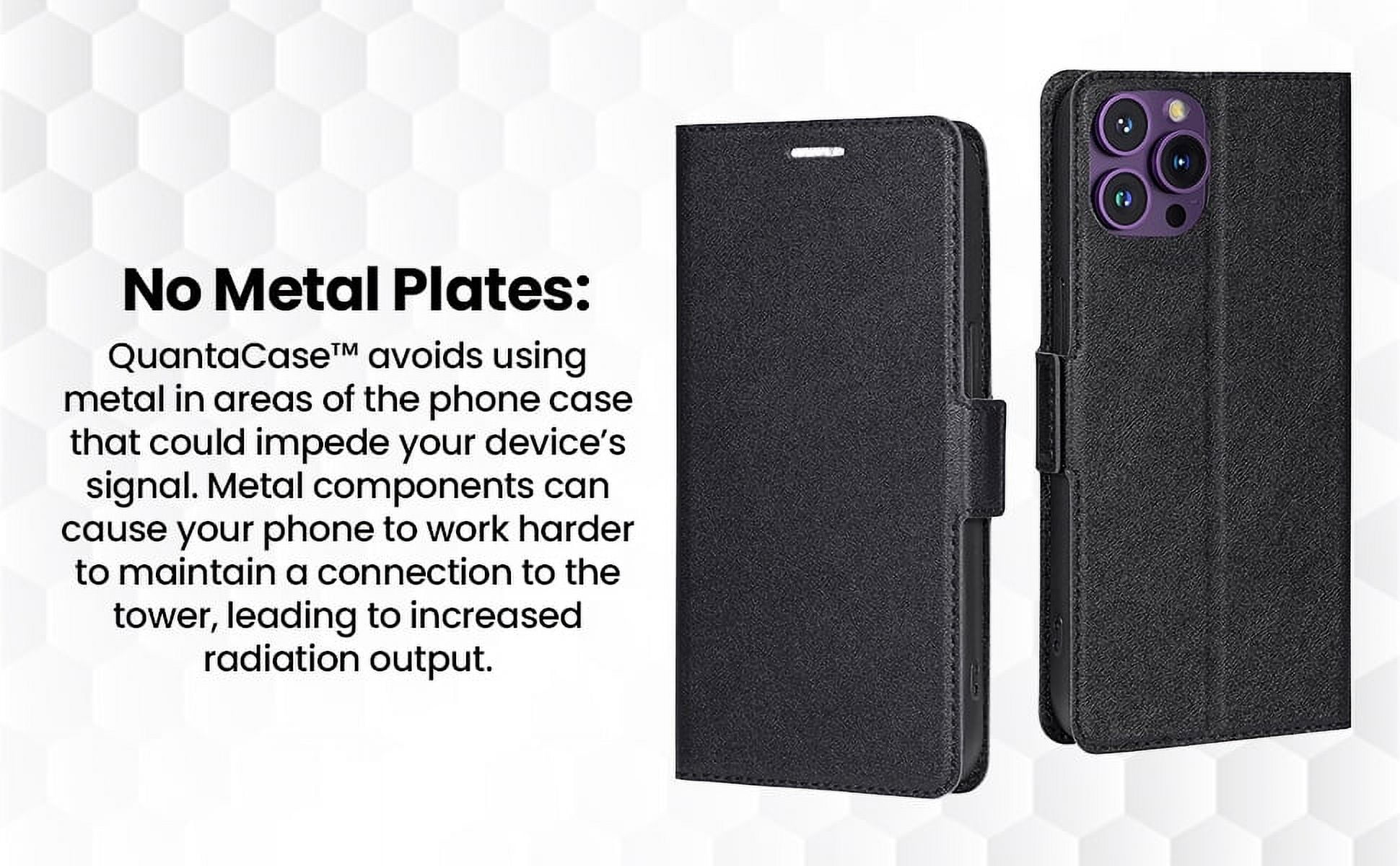
What sets QuantaCase apart for skeptics? Its features are directly informed by the evidence, avoiding common pitfalls that could worsen exposure. Unlike competitors with metal plates or loops that detune antennas and force phones to emit more (up to 70% increase per EWG tests), QuantaCase is ultra-thin and metal-free. This preserves signal, preventing amplified emissions tied to non-thermal risks.
The flip cover uses a conductive layer for deflection (not absorption, which can reradiate), achieving 85-90% reduction on the shielded side per independent tests on similar designs. A shielded speaker hole with conductive mesh blocks 5G frequencies during calls, addressing brain/ear vulnerabilities. The single RFID slot minimizes bulk for proper use, per research on multi-slot flaws.
Transparency shines: An exposed point lets users test conductivity with an ohmmeter, verifying shielding without disassembly—a rare feature in 2025 reviews. Instructions promote habits like flap closure and airplane mode, acting as a “training tool” for skeptics wary of gadgets.
Reviews echo this: Amazon users praise its slimness and signal preservation, while RF Safe’s 2025 guides highlight it as superior to absorption-based competitors.
Regulatory Realities: Why Guidelines Fall Short, and What QuantaCase Represents
QuantaCase’s core truth? Current FCC guidelines are inadequate, lacking justification for thermal-only focus amid non-thermal effects. The 2021 D.C. Circuit ruling deemed them “arbitrary and capricious” for ignoring non-thermal data, remanding for review—yet no changes by late 2025, despite Public Law 90-602 mandating ongoing research (halted post-NTP “clear evidence”). This inertia, amid corporate priorities, externalizes costs onto public health—especially children.
QuantaCase embodies skepticism: It reduces exposure modestly but truthfully, urging policy voices and tech shifts like Li-Fi for indoor data using native EMFs.
Why “Truthful”? Transparency and No Crazy Claims
QuantaCase earns its “TruthCase” name through unyielding honesty: No 99% protection boasts, no health cure-alls—just modest reductions amid gray zones. Even with it, exposure is high—focus on habits like duty cycle and orientation. For skeptics, this no-BS approach, plus verifiable shielding, builds trust in a market rife with snake oil.
Conclusion: Empower Skeptics—Demand Better
QuantaCase isn’t just a case; it’s a statement for RF skeptics demanding evidence over empty promises. By grounding design in real science, promoting transparency, and advocating systemic change, it empowers users to reduce risks while fighting for updated guidelines. If this resonates, test one, verify its shielding, adopt the habits—and join calls to enforce laws like Public Law 90-602. For a wireless world that’s truly safe, skeptics lead the way.